by Radia Jamee
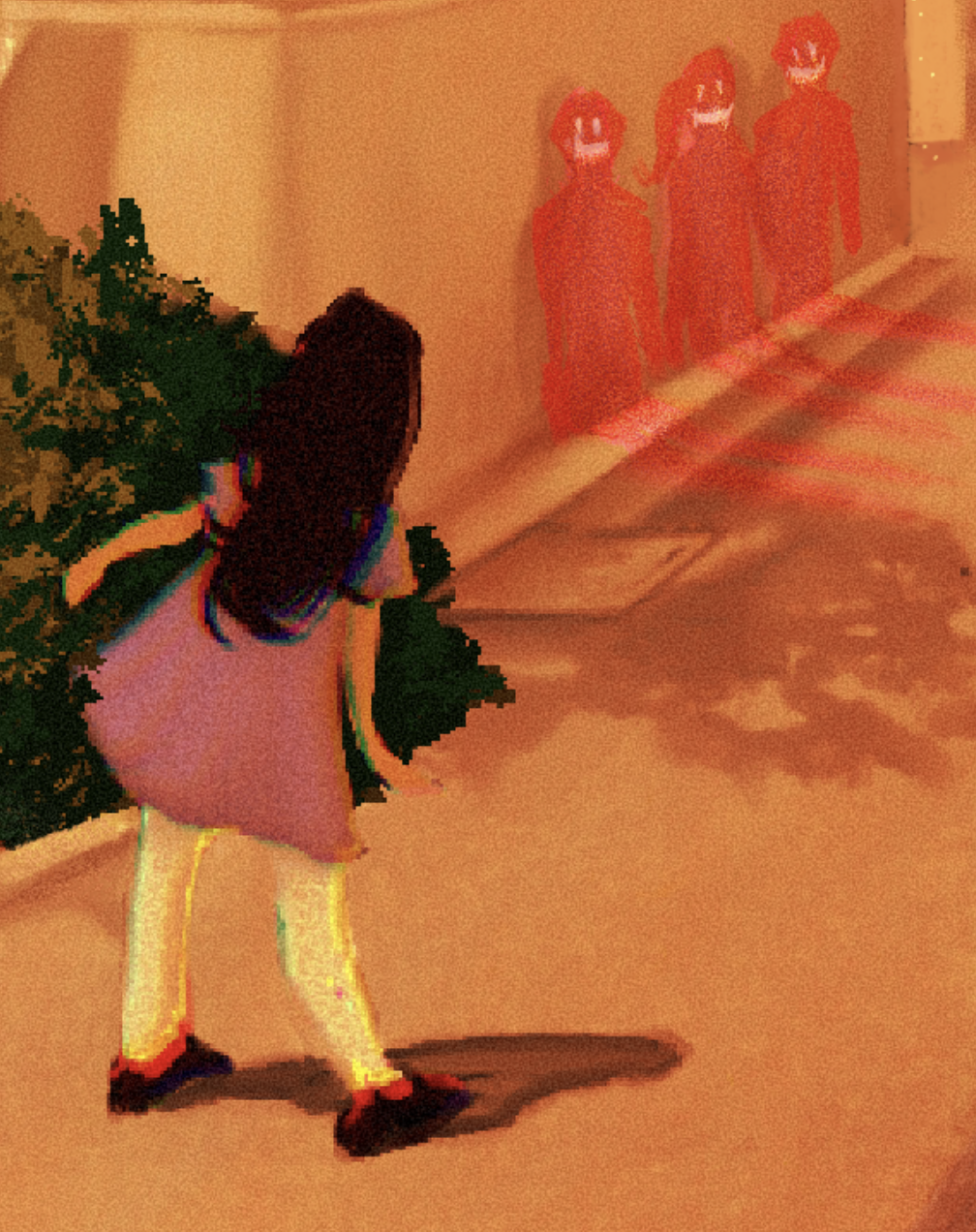
As Mar and Ayla turn the corner, there it is. A car idles by the curb, windows down, music playing low. Inside are faces she has not seen in years. Kai had been the big deal back in middle school—tall, blonde, a star on the soccer field. He was undeniably gifted in schoolwork too, a deadly combination, especially paired with a pride he never bothered to hide. His popularity was unmatched and so was his arrogance. Ayla always hung out with Kai, or more accurately, worshipped him. She wasn’t academically gifted by any means, nor did she stand out in any sports. But her long, dark brown curls, set against her pale skin and sharp, bright features, made her the center of attention on many occasions. Salel and Marha’s families knew each other fairly well, connected through the same close-knit ethnic community where social class didn’t matter, or at least wasn’t supposed to. While their love for their roots kept them part of the community, Salel’s parents were untouchably wealthy, which only meant there wasn’t a day when Salel was not embarrassed to admit he knew Mar outside of school.
“I didn’t do it,” said Marha, the 12-year-old “imposter” shouldering the weight of humiliation in a room full of people who already despised her. She looked slightly malnourished, her skin always seeming on the verge of cracking. Her shoes were battered, coated in the kind of dirt that doesn’t wash out, and whenever she was anxious, she had a habit of brushing the toes on her left foot with her right, which rubbed the toes off her left shoe. Tears streamed down her face, trailing past her dry, dull lips and down her neck, wetting the collar of her school uniform.
“Just look at her, stealing and lying so defiantly at this age is unbelievable. Her parents would have been so ashamed of her,” the professor sneered, his voice sharp enough to cut. Everybody at the school knew her parents died when she was four and that her grandmother raised her. Before she could breathe in the smoke that hung in the air from his words, a familiar voice from across the classroom cut through it.
“I am willing to bet it runs in the family.” It was the curly-haired, dark-skinned young boy with a mischievous smile, Salel.
Why would he say that?
Was that what people in the community whispered behind closed doors?
Before these thoughts could linger any longer, the professor cut him off, “No one asked for your opinion. We will deal with this in the principal’s office.” Then he turned to Marha and muttered, “I hope your pathetic excuse of being an orphan doesn’t work this time”.
A few weeks ago, Mar was sitting on the third-floor balcony at lunch, knees drawn to her chest, watching the world carry on beneath her like she wasn’t in it. Their school had five buildings, each with its own corners to hide in—places Mar often escaped to, but never for long. Her favorite was the “old building,” a three-story structure with an off-white, almost yellowed exterior and black iron railings. It was the original building from when the school first opened. Now it looked more like an abandoned asylum than a school. But what Mar liked about it was that it was not pretentious. It was not pretty. It was not glorified. It was just there, a building serving its purpose and being called ugly for it. Most importantly, it was not a place for the pretentious, pretty, self-glorified kids to hang out. But that day, as she sat there, she heard their voices arriving before their faces. Salel stepped out first with his perfect hair and sly smile, flanked by three other kids. “She’s eating an orange like it’s a five-course meal,” said one of the girls. “That’s adorable.”
“I heard her grandmother digs through the Sunday market trash,” Salel added. “Wait, I thought she had some uncle who funds her pathetic little family in exchange for—” Laughter erupted like gunfire, harsh and ugly, as another kid jumped in. “Oh, and talking about trash,” Salel said, grabbing the orange and throwing it into the trash. He leaned close enough for her to smell the faint chemical tang of his hair gel. “Seriously, though, why do you always eat out here? Does the cafeteria charge extra for dignity?” He reached out suddenly and tugged one of her curls just enough to make her flinch. “You should smile more.”
Mar didn’t know what had happened in the trash can. It had caught fire. By the time the teachers noticed, the other kids were long gone. Later, they found cigarettes in the trash, which, of course, Mar was blamed for. She insisted she hadn’t touched them, and somehow, they let her go with just a warning. However, it wasn’t the only time she got in trouble because of those kids. Every small act of chaos became a trap, and somehow, they always knew how to drag her down.
Salel steps out of the car and embraces Mar, to her shock. They haven’t seen each other since middle school. Kai comes to greet her too. That is when Mar sees the last person sitting in the car, Nick. Nick Kuroda. His eyes are a distinct shade of brown that turn amber when the sunlight hits them. He is quiet, but with a strong personality—other kids knew they couldn’t mess with him. The pastels of the uniform contrast with his dark hair. Today, he still looks the same, just older. The same lean, tall frame, strong chin, shy, unreadable eyes. Mar stands there, caught in a sudden blur of memory, uncertain how to feel.
Mar sits in the back seat, tucked into the far right corner beside Kai. Nick is sitting on her other side, quiet as ever. Up front, Salel is behind the wheel, with Ayla riding shotgun. Mar takes a good look around the car—the seats, the door handles, the things peeking from the seatback pockets. The car smells like smoky vanilla, like a lady wearing fancy perfume standing by a bonfire.
“So, Mar, are you still a bit of a nerd? What are you up to these days?” says Salel. Kai is quiet. Incredibly quiet, like he is almost certain it is not going to end well.
“I’m a freelance journalist,” she responds with an ever so slight reluctance.
“How’s that working out for you?”
“Good.”
“Hey, Mar, how’s Grandma?” Salel’s voice drops as he utters the words with obvious hesitation.
“She passed.” Mar replies in an apathetic voice. To her, these questions are hollow and insincere coming from someone who never showed a shred of respect or compassion for her poor grandmother. He can only pretend to be someone he is not. After all, people grow, but they do not change.
It feels strange to be in the same car with this bunch of people. They are long gone from Mar’s life, but somehow, the impact has never faded. She is surprised by how vividly she remembers everything, as if it had happened yesterday. As the song “Belle” by Garou plays softly on the radio, Mar keeps looking at Nick, like she has so much to tell yet so little to say. Finally, the melancholy of the tune and the thick silence in the air are broken by Nick’s voice. “I’ve missed you, Mar.” Mar’s chest starts to feel heavy. She lets out a soft sigh and closes her eyes; she can feel her heart pounding. She feels something else, something warm. Was it… tears?
Suddenly, the radio starts glitching, the song stuttering. Kai leans forward from the back seat. “Did we lose signal?”
“No, it is… still on,” Ayla says with a slight panic, tapping the screen. The station is still locked in. But the noise shifts, like a whisper hidden inside the static, a strange rhythm to it, almost like words.
“Did it just–” Salel gasps, but the sound cuts out again.
The radio makes a screeching noise like a fuse blowing, before dissolving into pure static.
I used to have a recurring nightmare, one that only came when I was going through the worst times. My surroundings changed, but the story always remained the same. I was trapped. Sometimes in a closet, sometimes in a tiny metal-lined room, once even in a coffin. Sometimes for days. Something was coming after me, something bad. I could hear them outside—screaming, laughing, spitting, tearing me apart with their words. They always teamed up. Who were they? Everybody I had known. And then one day, the nightmares changed. They were still excruciatingly painful, except someone would appear at the very end to unlock the door of wherever it was that I was trapped. It was him—my Nick Kuroda.
The school had exceptionally strict rules and regulations to uphold superficial concepts of discipline, and the school uniform was one such example. Grandma had saved a hand-me-down navy blue sweater from Mar’s paternal cousin for this fall, as she had hit a growth spurt. Not only was the sweater a decade old, but her cousin was also a boy, which meant that instead of the school’s required “button-down cardigans” for girls, it was an oversized crewneck sweater. When Mar arrived at school, her tiny feet carrying her through the nearly two-mile walk, the vice principal noticed only the sweater. The punishment was that he made her stand outside the school building, far from the reach of the heater, for the entire first period. It came as no surprise when she was welcomed into class with synchronized mockery and offensive remarks about her new sweater. “Did your grandpa’s ghost bring that for you?” “No, I think she stole it from someone’s dad!” “Now whose dad wears such ugly sweaters in the twenty-first century?” More comments were thrown her way, but she couldn’t make them out behind the chorus of laughter. But at least the classroom was warm.
Later that day when classes ended, Mar’s sweater was missing. She searched every corner, looked under the desks, and even checked the restrooms, nothing. Just as she gave up and stepped outside to walk back home in the chilly weather, she saw it. It was in flames. A crowd of kids gathered around the partially burned sweater like it was a bonfire. At the center of it all stood Kai and Salel. The kids were tossing random things into the bonfire, ketchup, food scraps, and drinks. Some stomped on the sweater, continuing until the flames sputtered and eventually died down, whether they meant to put it out or not. As she walked closer with dread, Kai said, “We added a little ‘edge’ to it,” striking a model pose in mockery, hands on his hips, his chin tilted up. “It is a fashion statement to reflect your tragic life, obviously.”
Mar was so used to this by that point that she didn’t tear up anymore. Completely numb, she just waited in silence for all the kids to leave so she could take home whatever was left of her sweater. The way Mar felt about her grandmother couldn’t be put into words. She would have protected anything her grandmother gave her, no matter how small, because she had seen firsthand how hard her grandmother struggled to build every piece of their life. Now, the sweater looked disgusting, with large holes and burnt edges, food scraps clinging to it like it had been dragged through the cafeteria trash. As Mar got close enough to grab it, grimacing, a hand quickly picked it up from the ground.
“I’m sorry. They’re not the nicest people,” said Nick.
“Then why are you friends with them?” Mar wanted to answer, but the words caught in her throat. She was shy, and speaking up never came easy.
“I wouldn’t be friends with them if it were a choice,” Nick said, somehow picking up on exactly what she was thinking. He put his hand in his pocket, fumbling around for a second before pulling out a mini KitKat. He extended it toward her with a small, hesitant smile. “Here is a peace offering, if you would like.”
It was somewhat of a fair excuse. Nick was new to the school that year. Mar didn’t know where he came from, not that she cared. Since Kai had always been the best-in-class, the “know-it-all,” the professor assigned Nick to his group for class projects. From then on, Mar had only ever seen Nick lingering in the vicinity while Kai and his gang bossed people around.
That was the first time Nick had spoken to Mar, but it wouldn’t be the last. He would greet her with a faint smile every day, and it made her rather uncomfortable. Not because it was unpleasant, but because it was unfamiliar. For as long as she had been at this school, she had known her place as an outsider. She never felt included in anything, or at least not in anything good. She had simply existed to amuse others with her failures and her dull existence. All of a sudden, Nick acknowledging her presence beyond that left her muddled at best. It stirred something unknown, a feeling she certainly didn’t know what to do with.
Mar had asked her grandmother not to pack lunches with strong smells, but whenever her grandmother got excited about making something out of the ordinary, she tended to forget. That day, it was eggs. The moment Mar unzipped her lunch bag at school, the smell hit the air like a slap. Pungent. Sulfurous. Instant.
Her grandmother had packed something she had made with boiled eggs, perhaps some sort of pickled dish—halved eggs, soft yolks, bathing in a sea of tangy vegetables. Her grandmother probably thought she was doing something sweet. She probably imagined that Mar would be delighted to try something new. She enjoyed her grandmother’s cooking a lot, after all. Instead, Mar’s face burned as she braced herself for what was to come. Before she could gather her thoughts, a group of classmates appeared, among them Kai and Ayla. She quickly began folding paper towels over the eggs, trying to mask the smell before closing the lid again.
“Oh, wow,” said Kai. “So now we know why you smell like that all the time!”
“Oh, Kai, come on, poor thing doesn’t get to eat and you are making fun of her food?” Ayla added with a derisive smile.
“Well, guys, if that is the problem I think I might have a solution,”one of the girls stepped forward from behind them. She was just another face that was constantly mean and entitled. She moved closer to Mar with a slow, deliberate kind of confidence. “If you are gonna bring that, you should eat this.”
In her hand was a wadded napkin, soggy with spilled juice, maybe ketchup, maybe ranch—or whatever the white goo was.
Laughter erupted. Some voices chimed in: “Yeah, eat it!” “It is almost as gross as you are!”
Mar’s fingers trembled as she held the napkin over her face. She wanted to run. She wanted to dissipate into the floor. But the weight of the stares, the jeers, the laughter pinned her in place.
“Come on, Mar,” someone whispered behind her, voice low and cruel. “Aren’t you so tough?”
Her teeth clenched. Every breath was heavy, weighing her down like she couldn’t move if she tried. She froze like a moth caught in a spider’s web. That is when some of the kids grabbed her. They held her back as the girl shoved it in her mouth. Her cheeks burned with pain and shock as she squeezed her eyes shut, jaw clenched, tears pricking at the corners of her eyes. She could feel her chest tightening. The sheer helplessness took over her.
“What is that? You’re not eating it, you silly. You have to take a bite!” one of the kids grabbed her jaw and forced her to bite into the napkin.
Mar couldn’t taste anything but the bitter sting of pain and humiliation in that moment. But the texture was something else entirely. It was like eating sand, if only sand were coarse and brittle—a dry, dusty, inescapable mass that scraped relentlessly against the inside of her mouth and left a harsh, choking scratch deep in her throat. She gagged, the cutting laughter around her sharpening like knives, every second feeling like an eternity. Tears streamed silently down her cheeks. At the edge of her blurred vision, Ayla stood with her arms crossed in front of everyone like a proud leader, watching—unmoved, detached. Buried behind all the cheering were Mar’s choked whimpers, unable to hide her dread. The napkin still lodged in her mouth, tears soaking her shirt, she could only fear what Ayla would do next. Suddenly, Ayla’s voice broke through the noise: “Mar.” “Mar?” “Mar!”

 Vox Inaudica